


Easy to sign up
Easy to sign up, great exchange features, simplest browser based wallet ever.
Buy Zcash instantly with Guarda — a secure non-custodial wallet supporting over 1M+ assets. No account is required, and you can pay with Visa, Mastercard, or SEPA to receive ZEC directly to your wallet. Enjoy fast, simple, and safe cryptocurrency purchases without intermediaries.

Thank you
Please complete your payment via Guardarian.
If you’re experiencing problems with your order, please contact our customer service team by e-mail at: [email protected]
Create new orderPayment Amount
You Get
Transaction Status
Payment Status
If you’re experiencing problems with your order, please contact our customer service team by e-mail at: [email protected]
Create new orderDownload Guarda Wallet
Install on Desktop, Mobile, or use Web Wallet — your choice of platform
Choose Amount & Currency
Enter the amount in ZEC or fiat (USD, EUR, GBP). See the estimated amount instantly
Enter Your ZEC Address
Provide the recipient ZEC wallet address (or use your Guarda wallet address)
Select Payment Method
Choose Visa/Mastercard or SEPA. Compare offers from Guardarian and Simplex
Confirm & Pay
Complete payment. ZEC arrives in your wallet within 5–30 minutes

Non-custodial
You hold your own keys and have full control over your funds

Secure
2FA & Face ID

Cross-platform
Access your wallets from any device, anywhere

Multi-currency support
Store and exchange tons of assets

Dynamic fees
Transaction fees adjust based on network congestion

24/7 human support
Representatives are available at all times

Payment methods


Payment methods
Join millions of users who trust Guarda for fast, secure crypto purchases.

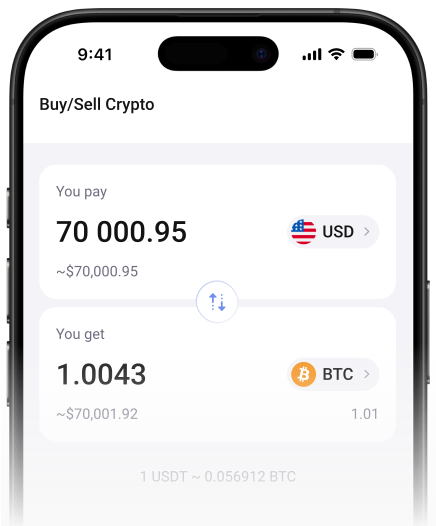
Available on iOS and Android. Buy, store, exchange and stake crypto — all from your phone.
Download the app

2 100+ reviews with average 4.3 score on TrustPilot
Easy to sign up, great exchange features, simplest browser based wallet ever.
Excellent wallet & Exchange. Well done. I’ve used a number of digital wallets for this coin or that coin, and multi chain. This is one of the better ones so far. Pretty intuitive while at the same time incorporating multi-chain swaps and exchanges (bridging) fairly transparently. Minimal fee’s to boot. A nice touch with the hierarchical structure of main net coin(s) and then subnet coin(s) below.
I'm very particular when it comes to crypto wallets, exchanges, etc. so when I had to find a way of moving DOGE off of an old wallet and saw the wallet options for some reason Guarda stood out. I am very happy I decided to try Guarda, as I now have another crypto wallet/exchange service that I feel safe to use. I am very impressed with the UI, how seamless and intuitive everything is - I am excited to use Guarda more, thanks!
 Buy Zcash in Australia
 Buy Zcash in Bangladesh
 Buy Zcash in Brazil
 Buy Zcash in Canada
 Buy Zcash in France
 Buy Zcash in Germany
 Buy Zcash in India
 Buy Zcash in Indonesia
 Buy Zcash in Italy
 Buy Zcash in Malaysia
 Buy Zcash in Nigeria
 Buy Zcash in Philippines
 Buy Zcash in Poland
 Buy Zcash in South Africa
 Buy Zcash in South Korea
 Buy Zcash in Spain
 Buy Zcash in Turkey
 Buy Zcash in UK
 Buy Zcash in United Arab Emirates
Availability in listed countries depends on partners. Please confirm directly.
The easiest route is a regulated cryptocurrency exchange that currently supports ZEC. Buyers create an account, complete KYC verification, fund it with a supported payment method, purchase ZEC, and withdraw it to a personal cryptocurrency wallet. Buyers seeking privacy should first confirm support for shielded z-address withdrawals. Learn how to top up your wallet with ZEC.
A suitable cryptocurrency exchange should support ZEC in your region, follow applicable regulations, publish transparent fees, and allow external withdrawals. Buyers who need Zcash transaction privacy should also confirm that the platform supports shielded z-addresses rather than only transparent t-address withdrawals.
ZEC can be stored in a non-custodial cryptocurrency wallet. Guarda supports everyday ZEC management and offers hardware-level protection through its Ledger integration. Full privacy often requires a dedicated wallet with shielded z-address support.
Zcash has an established privacy use case, but it also faces volatility, regulatory uncertainty, liquidity risk, and unstable exchange support. Zcash, like all cryptocurrencies, carries significant price volatility risk. Past performance is not indicative of future results, especially positive ones. This article does not qualify as financial advice and encourages buyers to do their own research.
A credit card or debit card is usually the fastest option but carries higher fees. A bank transfer normally costs less but can take one to five business days. PayPal, Apple Pay, or Google Pay may offer near-instant purchases in supported regions, with fees generally closer to card pricing.
After buying Zcash, secure and manage your assets with Guarda Wallet
Our support team is available 24/7 to help you with your purchase.





Get Zcash price alerts, market insights and Guarda updates delivered to your inbox.
We will only use your email to deliver news and updates
For more information, please see our Privacy Policy.
Download Guarda Wallet and hold your crypto assets safely, anytime and anywhere.