
What Is PAX Gold (PAXG)?
PAX Gold (PAXG) is an ERC-20 token issued by Paxos Trust Company. Each token represents one fine troy ounce of physical gold from a London Good Delivery bar. The underlying gold is kept in professional LBMA vaults in London, and Paxos acts as the token issuer and custodian. Basically, PAXG takes an asset that normally sits behind locked doors and gives it a blockchain address.
Paxos publishes monthly attestation reports covering the gold reserves behind PAXG. An independent accounting firm prepares the reports, which allow holders to verify that the circulating tokens are still linked to the underlying reserve structure. Paxos also has a lookup tool for allocations where you can find the serial number, weight, and vault information for eligible on-chain PAXG holdings. The physical backing is allocated, so the PAXG holder has a partial interest in specific physical bars held in Paxos's custody. As opposed to unallocated gold, where the customer normally has a broader claim against a provider and not a direct ownership connected to a particular bullion.
PAXG also differs from a traditional gold ETF. An ETF gives investors shares in a pooled financial product. PAX Gold represents direct ownership rights in a token that can move through the Ethereum blockchain:
- Fractional ownership—you do not need enough capital for an entire troy ounce or a full Good Delivery bar.
- On-chain transfers—PAXG moves between compatible Ethereum addresses without even touching physical bullion.
- Continuous market access—secondary cryptocurrency markets operate outside typical exchange hours.
- DeFi compatibility—PAXG interacts with compatible lending, trading, and collateral protocols.
- Physical redemption—eligible holders redeem PAXG through Paxos, subject to current minimums, fees, account requirements, and availability.
Each token is backed by one fine troy ounce of the underlying metal, so PAXG usually trades near the spot price of gold. It might not be the headline gold price, to the penny, at every point in time. Liquidity on cryptocurrency exchanges, spreads, demand and withdrawal costs can lead to temporary premiums or discounts.
How to Buy PAX Gold: Platforms and Payment Methods
Buying PAXG is different from buying a speculative cryptocurrency. Platform custody, token withdrawals, regional availability, and redemption conditions deserve even more attention than the displayed price. The complete process can take a few minutes with a card or several business days with a bank transfer.
1. Choose a cryptocurrency exchange that supports PAXG. Availability changes by region, and the platform should be checked before an account is funded. The exchange does not necessarily provide direct access to Paxos redemption services. It is possible for a platform to support PAXG trading without supporting conversion into physical gold. Buyers interested in redemption should examine the process before making the purchase. Review regulatory standing, custody conditions, regional PAXG availability, physical gold redemption access, supported fiat currencies, card and bank transfer support, KYC verification requirements, ERC-20 PAXG withdrawals, trading and withdrawal fees, and external cryptocurrency wallet support. Paxos currently notes regional restrictions on its official product page, including unavailability in the EU at the time of publication. Verify the latest position for your country and avoid assuming global exchange support means local access.
2. Create and secure the account. Most regulated platforms require KYC verification before enabling fiat money purchases, higher limits, or external withdrawals. The usual process includes personal details, government-issued ID, a selfie or live facial check, and a record of address in a few cases. Basic verification is often done quickly, but other reviews for compliance may take longer.
3. Choose a payment method. Account security should come before the first deposit. Create a unique password, enable 2FA (two-factor authentication), and activate an anti-phishing code if the exchange offers one. Gold may be an old-school asset, but a fake login page can still steal its digital version in a few minutes. Now, the purchase speed and total cost are affected by the payment method available. A credit card or debit card is the fastest route: transactions complete within minutes after KYC, but card processing fees and spreads are usually higher than with a bank transfer, and the issuer may treat the transaction as a cash advance. A bank transfer usually costs less and works better for larger purchases, with processing taking between one and five business days. PayPal, Apple Pay, and Google Pay may be available through selected providers for a near-instant purchase flow, though regional restrictions and card-level fees still apply. A cryptocurrency deposit lets existing crypto holders exchange another supported asset for PAXG, avoiding a new fiat deposit but introducing trading, spread, and blockchain transfer costs. Depending on the platform, supported fiat money may include US dollars, euros, British pounds, Canadian dollars, Australian dollars, or other regional currencies. Always confirm support directly because both PAXG and individual payment routes can be restricted by jurisdiction.
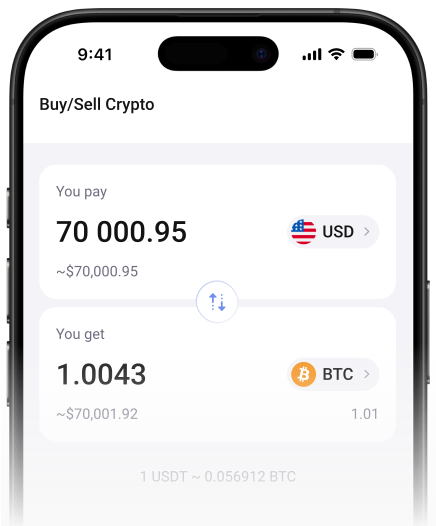
4. Buy PAXG and transfer it to a wallet. Search for PAXG, enter the purchase amount, and choose an order type. A market order buys PAX Gold at the best available current price. It prioritizes speed, although the final execution price can shift slightly. A limit order lets the buyer set the maximum price they are prepared to pay. When the market hits that level, the order will proceed. Paxos's current official page advertises zero on-chain transfer fees at the issuer level, but third-party exchanges and Ethereum network conditions still create costs. Fee schedules change, so the final transaction screen remains the source of truth. Also, PAXG tracks physical gold, so when you check the live gold price before buying, you get important context. The exchange quote should sit reasonably close to the value of one fine troy ounce after accounting for the selected purchase fraction and platform costs.
Full cost checklist before confirming the transaction:
- Deposit or payment-processing fee
- Exchange trading fee
- Spread
- PAXG purchase or creation charge, if applicable
- Withdrawal fee
- Ethereum network fee
- Custody or redemption fee, where relevant
After the order is complete, PAXG can be transferred to an independent ERC-20-compatible cryptocurrency wallet. Because in crypto, when not your keys, then not your coins.
How to Store PAX Gold — and What Else You Can Do With It
Self-custody is important even when the token represents gold in a professional vault. The physical metal may sit with Paxos, but the private keys still define who exactly controls the PAXG token connected to it. A personal ERC-20 cryptocurrency wallet keeps control with the holder and preserves access to transfers, swaps, and compatible DeFi services. Exchange custody is handy for active trading, but the exchange controls withdrawals and account access.
A non-custodial software wallet offers the practical middle ground between access and security. It keeps PAXG available for transfers and portfolio activity while generating and storing private keys under the user's control. Guarda Wallet supports PAXG in a non-custodial environment across desktop, mobile, web, and browser extension formats. The same wallet environment can manage PAXG alongside Ethereum and other supported assets. Since PAXG is an ERC-20 token, Ethereum network fees apply when moving it on-chain. MetaMask and other ERC-20 wallets may also support PAXG. Regardless of the interface, the receiving wallet must support Ethereum assets and display the correct PAXG contract.
For more valuable balances and long-term holdings, the highest-security tier is accessible through Guarda's Ledger integration. Every hardware wallet, including Ledger, requires physical confirmation before signing a transaction. The device stays disconnected from the internet and keeps private keys offline. Guarda acts as the asset-management interface, so users get software-level accessibility with a cold, protective layer.
Self-custody and cold storage are not the same thing. Guarda is non-custodial because users control the private keys, but it still interacts with the internet and blockchains. Hardware protection keeps those keys away from internet-connected devices completely. The seed phrase is the final recovery method in both cases. It should be written down physically, stored offline in more than one secure location, and never saved in screenshots, cloud storage, emails, chats, or ordinary note applications.
You can redeem PAXG through Paxos for physical gold or cash, depending on your account, the minimum amount, your region, and fees. Eligible holders can redeem PAXG for Good Delivery gold bars accredited by the LBMA. So, PAXG isn't just a token that tracks the price of gold. Each token represents a claim on actual allocated gold held in professional vaults in London. Because Good Delivery bars are large, physical redemption is mainly practical for bigger holders. Smaller investors will usually sell or transfer fractional PAXG instead.
PAXG reduces some of the practical problems associated with physical gold, but it introduces a new set of risks. Paxos states that every token is backed by allocated gold held in LBMA vaults, with monthly independent attestations. That structure gives holders more protection than an unbacked promise, but it does not remove dependence on Paxos, its custodians, regulators, and operational processes. PAXG depends on Ethereum infrastructure and smart contract functionality. Network congestion can increase transaction fees, while technical vulnerabilities or operational interruptions could affect transfers. Availability, redemption rights, and payment access vary by country. PAXG is not a bank deposit and is not covered by schemes such as the UK Financial Services Compensation Scheme or equivalent deposit guarantees.
A non-custodial wallet removes exchange custody but transfers recovery responsibility to the holder. Losing both the wallet access and the recovery phrase may mean losing access entirely.