Wallet Basics
Address
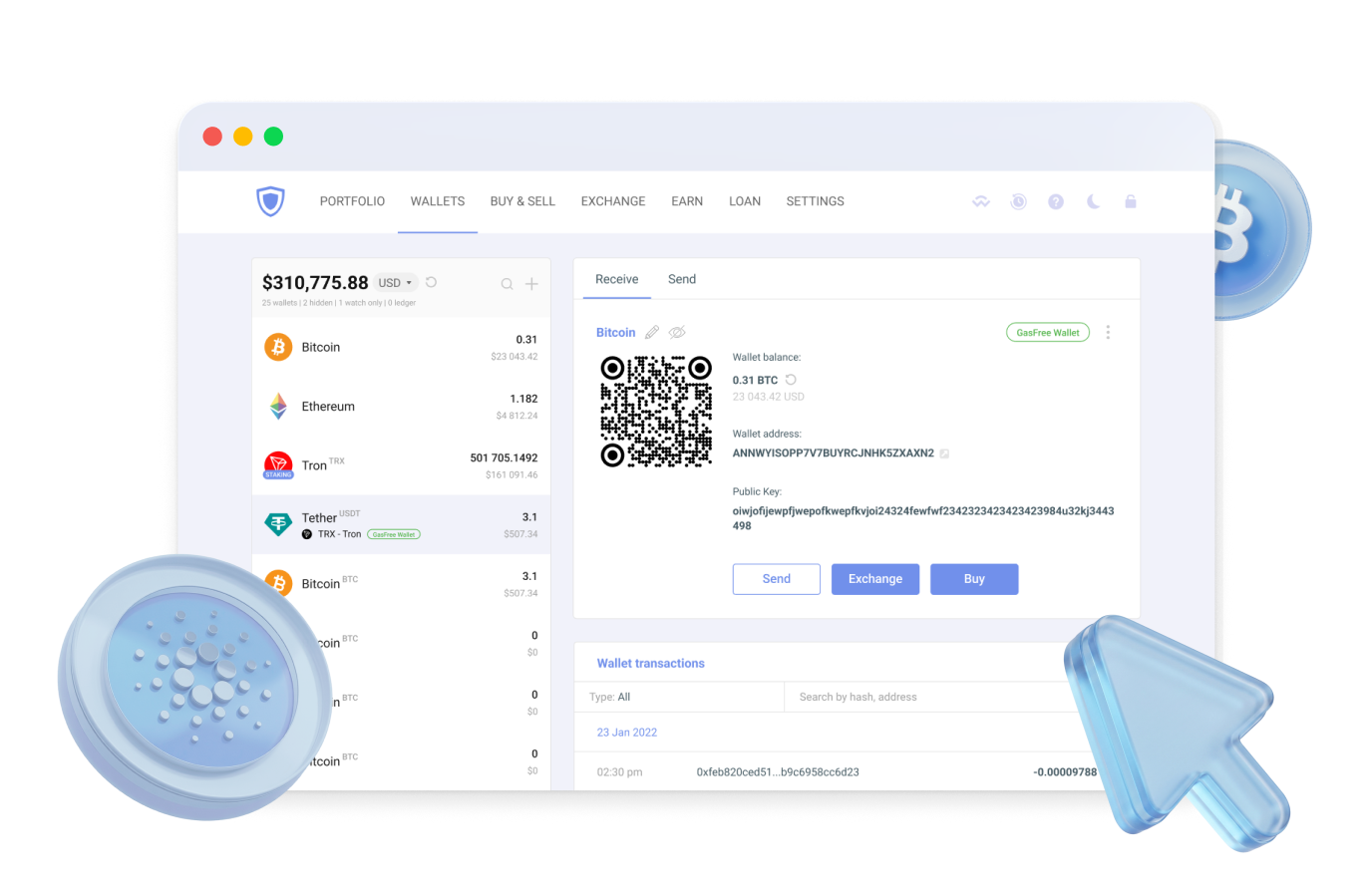
A wallet address is a unique string of letters and numbers you share to receive cryptocurrency. Every blockchain has its own address format. It works similarly to a number of your bank accounts: you can share it and receive funds, but no one is able to calculate your government ID out of it.
Backup
A backup is an encrypted file containing information about your Guarda wallet. It allows you to restore your wallet, including all supported wallets you've created. When you add or remove a wallet, you get a notification about your backup being updated and ready to download. Remember to save a new backup for the smoothest usage and recovery experience.
Custodial Cryptocurrency Wallet
A custodial crypto wallet is a software app where a third party stores your private keys on your behalf. Centralized exchanges (CEX) are the most common example. It is more similar to a banking app because CEX has control over your access and recovery information. A custodial wallet is actually able to cancel some internal transfers or help you restore the access to your wallet. But it is also able to freeze your assets and limit your access to them.
Non-Custodial Cryptocurrency Wallet
A non-custodial crypto wallet is a software application that lets you manage your digital assets on a blockchain while keeping control of your private keys. Just like a banking app, your wallet doesn't store your actual money—it stores the credentials that give you access to them and allows you to send, receive, store, and manage your crypto, but there is no bank or third party over you.
Multi-currency Wallet
A multi-currency wallet supports many different cryptocurrencies in a single application. Instead of installing a separate wallet for each blockchain, you can manage Bitcoin, Ethereum, Solana, and many other assets in one place.
Password
Your password protects access to your Guarda wallet on your current device. It does not recover your wallet or your funds alone, but it is necessary and important. If you lose access to your device, you'll need your backup, mnemonic, or private key to restore your wallet, but you’ll be able to do it only if you have your password on hand.
Private Key
A private key is a secret cryptographic key that gives you full control over a specific wallet. Anyone with access to your private key can access the assets stored in that wallet. It has a value of your passport, bank PIN, and a legal signature combined. Never share your private keys with anyone.
Public Key
A public key is a cryptographic key used to generate your wallet address. While they are closely related, your wallet address is a shortened, user-friendly version of the public key. Both can be shared safely without putting your funds at risk.
Recovery Phrase (Mnemonic)
A recovery phrase, also called a mnemonic or seed phrase, is a sequence of 12, 18, or 24 words that can restore your wallet and its assets. These are random combinations of 2,048 words contained in the standardized BIP-39 word list. A mnemonic is the master key to your wallet. Store it offline and never share it—anyone who knows your recovery phrase can control your crypto.
Sending & Receiving
Blockchain Network
A blockchain network is the decentralized computing system that processes and records cryptocurrency transactions. There is no single CEO that makes decisions on behalf of the others. Instead, blockchain networks follow rules built into their code. Examples include Bitcoin, Ethereum, BNB Smart Chain, Polygon, Solana, and TRON. Always make sure you're using the correct network when sending or receiving crypto.
Confirmations
A confirmation means your transaction has been accepted by the blockchain and included in a block. Each new block adds another confirmation, making the transaction increasingly difficult to reverse. Confirmations don't verify who sent the transaction or whether the transferred asset is legitimate—they only confirm that the blockchain has processed it. Most cryptocurrencies require several confirmations before funds become fully available. More confirmations generally mean greater security.
Gas Fee (Network Fee)
A gas fee, also called a network fee, is the cost of processing a blockchain transaction. It is paid to the blockchain's validators or miners for processing and securing the network. You do not pay those fees to Guarda or any wallet. The fee depends on the blockchain and current network activity.
Failed Transaction
A failed transaction is one that wasn't successfully processed by the blockchain. This can happen because of insufficient network fees, smart contract errors, or other technical reasons. Depending on the blockchain, network fees may still be charged even if the transaction fails.
Transaction (Transfer)
A transaction is the process of sending cryptocurrency from one wallet address to another. Once it's confirmed by the blockchain, it usually cannot be reversed. Always double-check the recipient address and network before sending funds.
Transaction ID (TXID / Hash)
A Transaction ID (TXID), also called a transaction hash, is a unique identifier assigned to every blockchain transaction. You can use it to track the transaction, check its confirmation status, or share it with support if needed.
Pending Transaction
A pending transaction has been submitted to the blockchain but hasn't been confirmed yet. This usually happens because the network is busy or the transaction is still waiting to be processed. Most pending transactions are completed automatically once they're confirmed, which usually takes 5-30 minutes or more.
Assets
Native Coin
A native coin is the main cryptocurrency of a blockchain network. For example, BTC on Bitcoin, ETH on Ethereum, SOL on Solana, and BNB on BNB Smart Chain. It's typically used to pay network fees and secure the blockchain.
Token
A token is a cryptocurrency created on top of an existing blockchain, like USDT or LINK on Ethereum. Tokens rely on established rules and coins instead of running their own blockchain.
Stablecoin
A stablecoin is a cryptocurrency designed to maintain a stable value, usually by being pegged to a fiat currency like the US dollar or euro. Popular examples include USDT, USDC, and DAI. Stablecoins are commonly used for trading, payments, and reducing exposure to market volatility.
NFT
An NFT (Non-Fungible Token) is a unique digital asset stored on a blockchain. Unlike cryptocurrencies, NFTs aren't interchangeable. You can use one or another USDT on Ethereum, and it won’t make any difference, but each NFT has its own identity and ownership history. NFTs can represent digital art, collectibles, game items, domain names, and more.
Exchanges & Ownership
Centralized Exchange (CEX)
A centralized exchange (CEX) is a platform where you can buy, sell, and trade cryptocurrencies. Examples include Binance, Coinbase, Kraken, and OKX. They are regulated by a lot of jurisdictions. A CEX keeps custody of users' crypto, which makes the transactions fast and even refundable. But it also stores your private keys on your behalf. It is easier to recover your account, but it’s CEX who controls access to your assets.
Decentralized Exchange (DEX)
A decentralized exchange (DEX) is a system that lets you swap cryptocurrencies directly from your own wallet without creating an account or giving custody of your funds to a third party. Instead of trusting an exchange, transactions are executed by smart contracts on the blockchain, reducing the human factor almost completely
Self-Custody
Self-custody means you, and only you, control your wallet's private keys and recovery information. No company can freeze your assets, reset your password, or recover your wallet for you. With that freedom comes the responsibility of keeping your recovery information safe.
Web3
dApp
A decentralized application (dApp) is an application that runs on a blockchain instead of centralized servers. You can use dApps for trading, gaming, NFTs, lending, staking, and many other blockchain services. Most dApps require you to connect a compatible wallet before you can use them.
Smart Contract
A smart contract is a program deployed on a blockchain that automatically executes when predefined conditions are met. The most simple way to put it is a vending machine. When the penny goes in and the product is chosen, a vending machine gives out the result without needing human control. Smart contracts power decentralized exchanges, NFT marketplaces, staking, lending protocols, and many other Web3 applications.
WalletConnect
WalletConnect is a secure protocol that connects your wallet to a decentralized application without sharing your private keys. Instead of entering sensitive information, you simply approve connection requests from your wallet.
Web3 Wallet
A Web3 wallet is a crypto wallet that can interact with decentralized applications and smart contracts. Besides sending and receiving cryptocurrency, it lets you connect to dApps, sign transactions, and manage digital assets across different blockchain ecosystems.

Swaps
Crypto Swap
A crypto swap lets you exchange one cryptocurrency for another without placing a traditional buy or sell order. Depending on the service, swaps may happen through decentralized liquidity pools or external exchange providers.
Liquidity
Liquidity is the amount of cryptocurrency available for trading or swapping. High liquidity usually results in faster trades and more stable prices, while low liquidity can lead to larger price differences during a swap.
Slippage
Slippage is the difference between the expected exchange rate and the final rate you receive. It usually happens when market prices change or when there isn't enough liquidity to complete the swap at the quoted price.
Security
Dusting Attack
A dusting attack is when someone sends a tiny amount of cryptocurrency to many wallet addresses without the owners requesting it. While receiving these funds doesn't put your wallet at risk, scammers may use them to attract attention or attempt blockchain analysis. The safest option is to ignore unexpected transactions.
Scam
A crypto scam is any attempt to trick you into sending funds, revealing recovery information, or approving malicious transactions. Scammers often impersonate support teams, exchanges, investment platforms, or well-known crypto projects. If something sounds too good to be true, it probably is and is worth being skeptical.
Signature Request
A signature request asks you to prove ownership of your wallet or approve an action without necessarily sending cryptocurrency. While many signature requests are legitimate, malicious ones can authorize unwanted actions. Always research what and why you're signing before approving it.
Token Approval
Some decentralized applications ask for permission to access specific tokens in your wallet. This permission is called a token approval. Always review what you're approving, since malicious or unlimited approvals may allow a smart contract to spend your tokens.
Phishing
Phishing is a type of scam that uses fake websites, emails, messages, or social media accounts to steal your passwords, recovery phrases, or private keys. Always verify website addresses and be mindful about links you follow. Never enter your recovery phrase anywhere except your wallet during recovery.
Advanced
Cross-chain
Cross-chain refers to applications, transactions, or technologies that work across multiple blockchain networks. For example, a cross-chain wallet can manage assets on different blockchains, while a cross-chain swap lets you exchange assets between two networks without doing multiple manual transfers. Cross-chain technology improves interoperability, allowing blockchains that normally operate independently to communicate and exchange value.

DeFi
DeFi (Decentralized Finance) is a collection of financial services built on blockchain networks without traditional banks or intermediaries. Through DeFi, users can lend, borrow, trade, stake, and earn rewards directly from their wallets using smart contracts instead of a third-party regulator.
DAO
A DAO (Decentralized Autonomous Organization) is a community governed by rules written into smart contracts instead of a central authority. Members typically vote on proposals using governance tokens, allowing decisions to be made collectively.
Layer 2
A Layer 2 network is built on top of another blockchain, mostly to improve speed and reduce transaction costs. Popular Layer 2 networks for Ethereum, for example, include Arbitrum, Optimism, Base, and zkSync.
Mining
Mining is the method to secure a Proof-of-Work blockchain network. When you mine, you dedicate a lot of computational power and electricity to earn rewards in return. Not every cryptocurrency supports mining, since it is genuinely hard and costs a lot. The mechanism was introduced in Bitcoin’s Whitepaper by Satoshi Nakamoto
Miner
A miner participates in verifying transactions and helps maintain a proof-of-work blockchain. Miners keep the network secure and receive monetary rewards for their work from the blockchain. When you pay network fees, you pay those miners via protocol.
Node
A node is a computer connected to a blockchain network. It stores a copy of the blockchain, verifies transactions according to the network's rules, and shares new information with other nodes. Together, thousands of independent nodes keep the network decentralized, secure, and available around the clock.
Staking
Staking is the method to secure a Proof-of-Stake blockchain network. When you stake, you lock certain cryptocurrencies for some time and earn rewards in return. Not every cryptocurrency supports staking, since there are several other methods to provide security. Rewards are also not fixed, and they vary depending on the network.
Validator
A validator participates in verifying transactions and helps maintain a proof-of-stake blockchain. Validators keep the network secure and receive monetary rewards for their work from the blockchain. When you pay gas fees, you pay those validators via protocol.