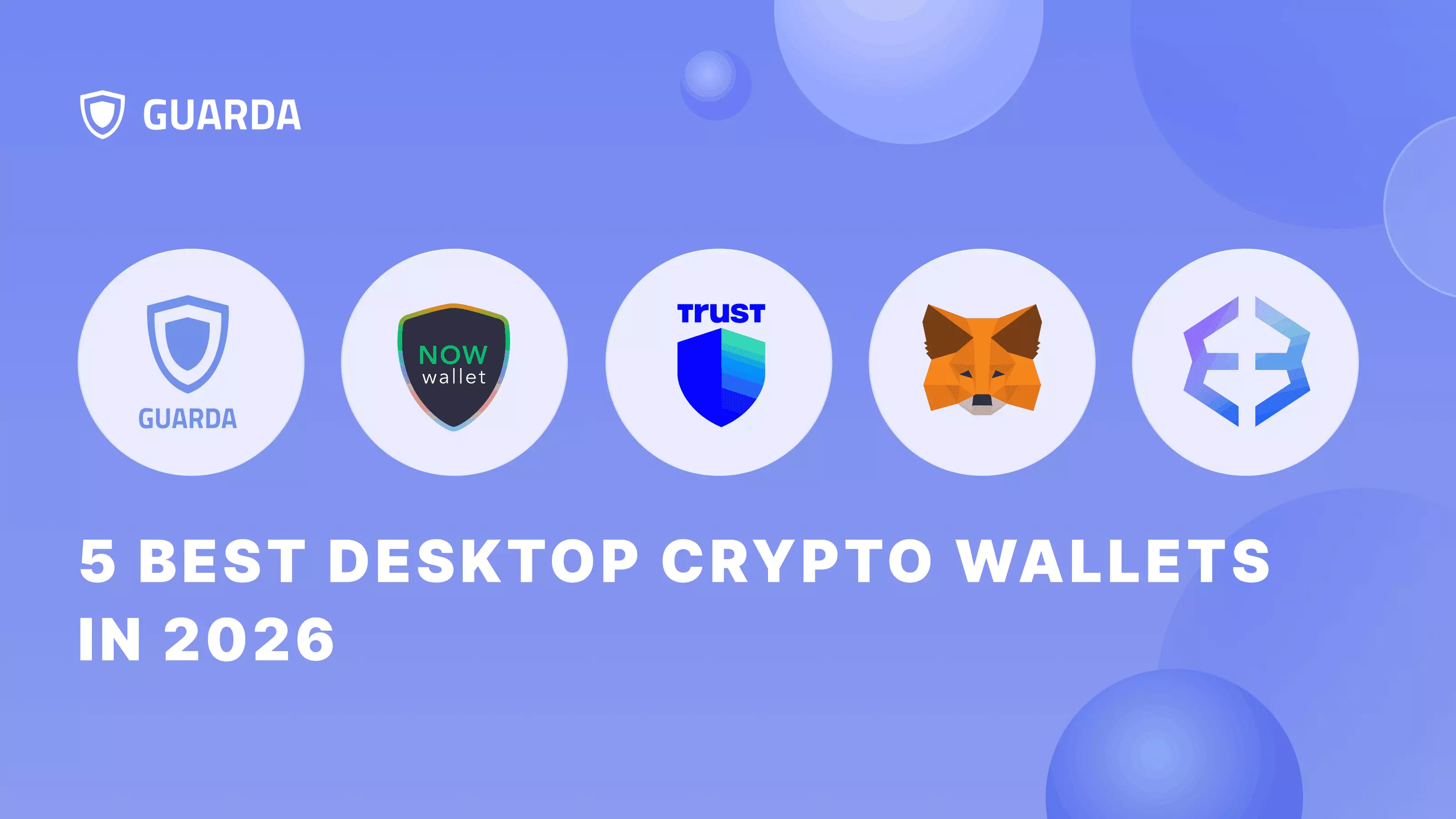
5 Best Desktop Crypto Wallets in 2026
Managing crypto from a computer gives you more screen space, easier portfolio management, and a comfortable environment for handling multiple assets. When choosing the best desktop crypto wallet, remember that some wallets offer a native desktop application, and others bring their mobile or Web3 experience to computers through a browser extension.
Experienced crypto life rarely stays within one chain, one asset, or one action. Bitcoin and non-EVM assets, for example, sit alongside tokens and Web3 networks. The best desktop wallet should be able to keep up with that complexity without forcing you to rebuild your workflow every time your portfolio outgrows what the wallet can handle.
Best Desktop Crypto Wallets Compared
| Wallet | Desktop Experience | Blockchain Coverage | Best For |
|---|---|---|---|
| Guarda Wallet | Native Windows, macOS and Linux apps + Web + Extension | 70+ blockchains, 1M+ assets | Complex multi-chain portfolio management |
| NOW Wallet | Native Windows, macOS and Linux apps | 70+ blockchains, 1,500+ listed tokens | Simple multi-chain desktop management |
| Trust Wallet | Browser extension | 100+ blockchains, 10M+ assets | Web3 users who already use Trust Wallet |
| MetaMask | Browser extension + Web | Multi-chain with strong Web3 focus | dApps and on-chain activity |
| Exodus | Native Windows, macOS and Linux apps | 50+ networks, 1M+ assets | Simple desktop portfolio management |
1. Guarda Wallet
Guarda is a non-custodial crypto wallet and has dedicated applications for Windows, macOS, and Linux. Private keys remain under the user's control, but the same framework is also available through Guarda Web, Browser Extension, and mobile apps.
But the bigger advantage shows up when a crypto portfolio becomes more complicated than when you started. Guarda brings complex moving parts into the same self-custodial environment. It supports 70+ blockchains and 1+ million assets, including BTC, ETH, SOL, XRP, TRX, XMR, and more, while giving users access to sending, receiving, swapping, staking, buying, selling, and using additional services from the broader Guarda ecosystem.
The breadth in this case creates something more useful than a long feature list: continuity. You can expand what you do with crypto without immediately having to move assets into another wallet, learn an entirely different interface, or give up self-custody.
Pros
- Dedicated desktop applications for Windows, macOS, and Linux
- 70+ blockchains and 1M+ assets supported
- Strong coverage of both EVM and non-EVM ecosystems
- Non-custodial control of private keys
- Built-in swaps and staking
- Buy and sell functionality
- Broader ecosystem includes crypto-backed loans and additional financial services
- Web, Extension, Desktop, and Mobile versions
- 99.9% of success rate across key wallet operations
- Designed for continuity as portfolios and workflows become more complex
Cons
- Large number of features may take some time to explore
- Availability of individual services depends on the asset and region
Best for: users managing increasingly complex multi-chain portfolios who want one self-custodial wallet to remain useful as their crypto activity expands.
2. NOW Wallet
NOW Wallet combines a non-custodial wallet with the crypto infrastructure of the ChangeNOW ecosystem. Its desktop application currently advertises support for 70+ blockchains and 1,500+ tokens, while EVM-compatible tokens can also be added manually. Its asset list includes major networks such as Bitcoin, Ethereum, Solana, XRP, and Dogecoin.
NOW Wallet also integrates closely with ChangeNOW. Users can exchange crypto and access fiat-to-crypto services while keeping the wallet itself non-custodial. Desktop and mobile versions can be synchronized, which is a genuine advantage if you regularly move between devices.
Pros
- Dedicated desktop experience
- 70+ blockchain networks
- Non-custodial wallet
- Built-in crypto swaps
- Staking for supported assets
- Desktop and mobile synchronization
- WalletConnect support for dApps
Cons
- Smaller native token catalog than some larger multi-chain competitors
- Many additional services are closely connected to the ChangeNOW ecosystem
Best for: users who want a multi-chain wallet with convenient access to ChangeNOW services.
3. Trust Wallet
Trust Wallet is one of the largest self-custody wallets in crypto and supports a broad range of assets and blockchain networks. It combines asset management with swaps, buying and selling, earning features, NFTs, and dApp access.
However, Trust Wallet's desktop experience is primarily browser-based rather than a dedicated native Windows, macOS, or Linux application. That isn't necessarily a disadvantage if your main goal is Web3. A browser extension puts the wallet directly beside the dApps you're using. But as activity becomes more complex, users specifically looking for a standalone desktop hub may prefer a wallet built around a native desktop client.
Pros
- Broad blockchain and asset coverage
- Strong Web3 and dApp functionality
- Buy, sell, swap, and earning features
- Self-custodial
- Large existing user base
Cons
- No traditional native desktop application
- Desktop workflow centers on the browser extension
Best for: multi-chain Web3 users who prefer managing crypto directly from their browser.
4. MetaMask
MetaMask remains one of the most recognizable wallets for interacting with Web3. Its desktop experience is also built primarily around the browser.
MetaMask has expanded beyond its original Ethereum focus, but its identity remains centered around Web3 interaction. The browser “desktop” solution is convenient for connecting to dApps, DeFi protocols, NFT platforms, and other on-chain applications. But the experience becomes less universal when your crypto activity moves into broader multi-chain asset management and non-EVM networks.
Pros
- Excellent dApp connectivity
- Familiar interface for DeFi users
- Available across major desktop browsers
- Strong ecosystem and developer adoption
- Self-custodial
Cons
- No traditional standalone desktop application
- Browser-first workflow may not suit users looking for a desktop portfolio hub
Best for: active Web3 and DeFi users who spend most of their time interacting with dApps.
5. Exodus
Exodus is a self-custody wallet with native applications for Windows, macOS, and Linux. Its desktop app focuses on making the basics easy to navigate, with portfolio tracking, sending, receiving, swaps, and staking available through a clean visual interface.
That simplicity works well for straightforward portfolio management, but experienced users may eventually run into its limits. Compared with Guarda, Exodus supports fewer blockchain networks and offers a narrower ecosystem around the wallet. Users whose activity expands across more networks, services, and advanced crypto workflows may therefore need additional tools alongside it.
Pros
- Native applications for Windows, macOS, and Linux
- Simple and polished interface
- Built-in swaps and staking
- Portfolio tracking
- Hardware wallet connectivity
Cons
- Fewer supported blockchain networks than Guarda
- Narrower range of integrated crypto services
- Less suitable for complex multi-chain workflows
- Users with more advanced requirements may need additional wallets or services
Best for: users who want a simple native desktop wallet for everyday portfolio management.
Which Desktop Crypto Wallet Is Best?
The right desktop wallet depends on how complicated your crypto life has become. Trust Wallet and MetaMask are strong choices when browser-based Web3 activity is the priority. Exodus provides a simple standalone client for portfolio management. NOW Wallet offers a straightforward multi-chain experience connected to the ChangeNOW infrastructure.
Guarda Wallet is built for continuity as that activity expands. You can start with basic storage and eventually manage multiple chains, non-EVM assets, tokens, staking, swaps, integrations, different devices, and recovery scenarios. Your ambitions don’t automatically outgrow the wallet. Guarda combines native applications for Windows, macOS, and Linux with 70+ blockchains, 1M+ assets, self-custody, and cross-platform access, while key wallet operations maintain a success rate of at least 99.9%.
You don’t have to stick to one wallet for the sake of having one wallet. It's about finding a wallet you don't have to leave as your crypto life becomes more complex.